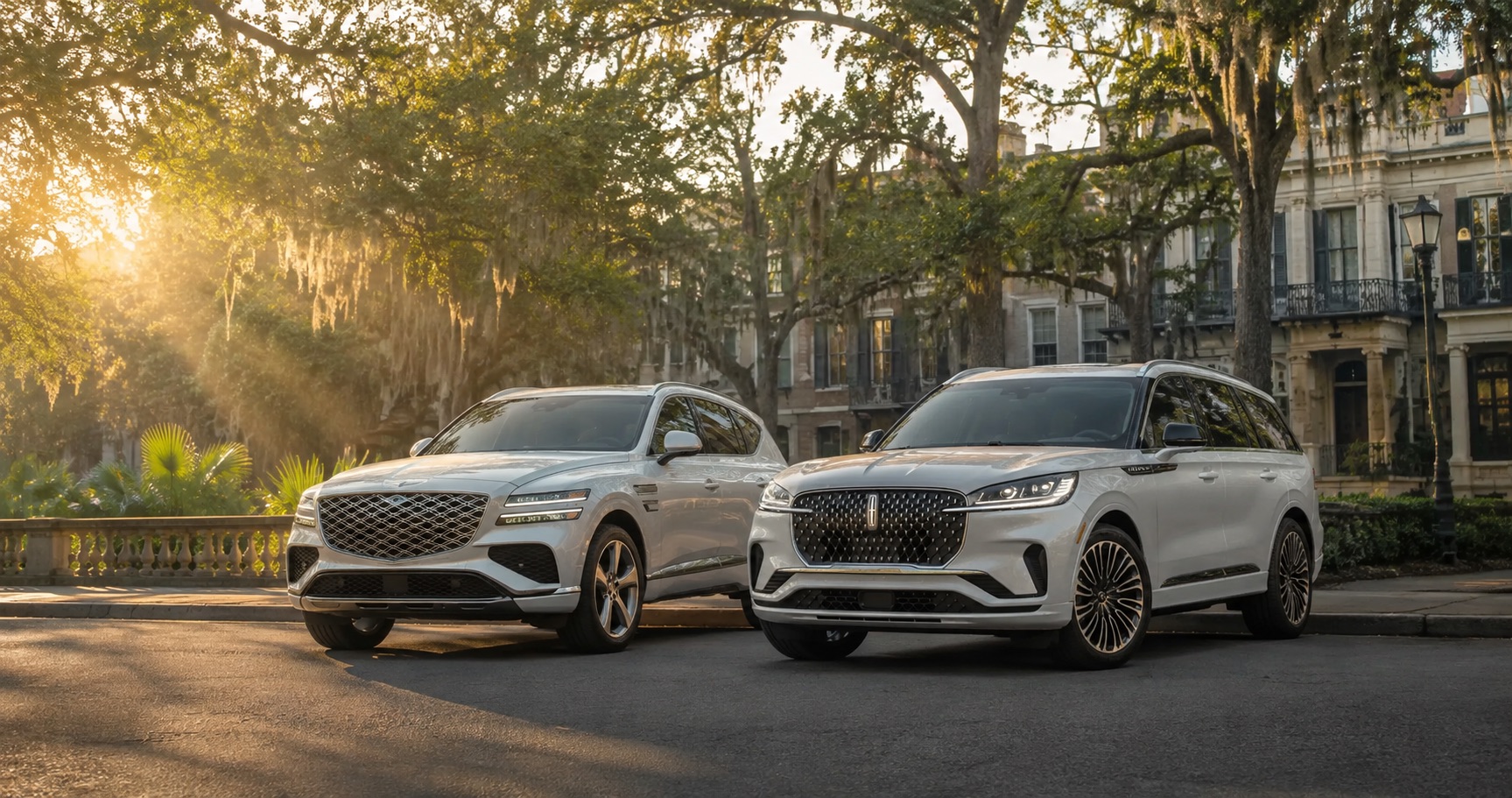
A Midsize Luxury SUV Comparison for Coastal Georgia
2027 Lincoln Aviator vs Genesis GV80
Standard V6 Power & Included BlueCruise or Better Base Efficiency, Longer Coverage & More Trim Choice?
The Better Fit Depends on Which Advantages Matter Most in Daily Use.
The 2027 Lincoln Aviator and Genesis GV80 sit within about $600 of one another on their manufacturer-published starting figures, but they allocate that money differently. Lincoln makes its twin-turbo V6 and four years of BlueCruise standard; Genesis opens with a turbo four-cylinder, more powertrain and trim choice, and a more generous factory ownership package.
That makes this a luxury-priority decision rather than a feature-count contest. Aviator puts more emphasis on standard performance and hands-free highway ease. GV80 counters with better entry fuel economy, more towing headroom, a display-forward cabin, and longer warranty and maintenance coverage. Some of those gaps are large while others are modest, so the comparison below keeps the size of each difference in view.
For Savannah and the coastal I-95 corridor, the useful question is which advantages you will actually notice between in-town driving, airport runs, family trips, and longer Lowcountry travel. That means weighing real seating and cargo needs alongside power, highway-assistance technology, ownership support, and the finished price of the configuration you would buy.
Buyer-Fit Shortcuts
Start With the Luxury-SUV Difference You Care About Most
Choose the difference that matters most. The result is a starting point, not a forced winner, and each card keeps the strongest counterargument in view.
Your Best Starting Point
Maximum Standard Power
Start With the Lincoln Aviator
Why It Fits
Aviator makes its 3.0-liter twin-turbo V6 standard at up to 400 horsepower and 415 lb-ft. That is 100 horsepower, or about 33%, more than the GV80 2.5T at their published entry prices, without requiring a move into a higher powertrain tier.
Also Compare
GV80 is still worth comparing if you would rather trade some standard output for better base fuel economy, a lower-output four-cylinder option, or the flexibility to step into its 375-horsepower V6 later.
Your Best Starting Point
Better Base Fuel Economy
Start With the Genesis GV80
Why It Fits
The GV80 2.5T RWD is rated at 20 mpg city and 26 mpg highway, versus Aviator RWD at 17/25. The difference is more pronounced in city driving—3 mpg—than on the highway, where the gap is 1 mpg; Genesis also gives up 100 horsepower in that entry configuration.
Also Compare
Aviator is the stronger alternative if you would rather accept the fuel-economy trade-off for substantially more standard output, especially when quick merging, full-passenger travel, or effortless passing response matters more.
Your Best Starting Point
Hands-Free Highway Driving
Start With the Lincoln Aviator
Why It Fits
Every 2027 Aviator includes four years of Lincoln BlueCruise access for hands-free driving on designated Blue Zones while the driver remains attentive. For frequent controlled-access highway travel, that is a clear standard-equipment distinction.
Also Compare
GV80 includes Highway Driving Assist 2, which can help center the vehicle and manage following distance and speed, but Genesis does not position it as the same hands-free highway-driving system.
Your Best Starting Point
Longer Warranty + Included Maintenance
Start With the Genesis GV80
Why It Fits
Genesis provides 5 years/60,000 miles of new-vehicle coverage and 10 years/100,000 miles of engine-and-transmission coverage for the original retail owner, plus complimentary scheduled maintenance for 3 years/36,000 miles and a three-year Service Valet subscription.
Also Compare
Lincoln counters with 4 years/50,000 miles of bumper-to-bumper coverage, 6 years/70,000 miles of powertrain coverage, and 4 years/50,000 miles of Pickup & Delivery service. The gap is real, but both brands build convenience into ownership.
Your Best Starting Point
Higher Tow Rating
Start With the Genesis GV80
Why It Fits
Current GV80 specifications list up to 6,000 pounds of braked-trailer capacity, versus 5,000 pounds for the Aviator when properly equipped. That is a 1,000-pound, or 20%, headline advantage before exact hitch, payload, passenger, cargo, and equipment limits are considered.
Also Compare
Aviator may still be the better road-trip fit if your trailer stays well below 5,000 pounds and its stronger standard engine, BlueCruise, longer wheelbase, or Lincoln ownership support matters more than the final 1,000 pounds of rating.
Your Best Starting Point
Three-Row Family Packaging
Compare Aviator & GV80
Why It Fits
Both can seat up to seven, but the useful packaging advantages split. Aviator provides 16.5 cubic feet behind its third row versus 11.6 for a three-row GV80; GV80 publishes 30.3 inches of third-row legroom versus 29.2 in the Aviator, and its third row is standard on every 2027 trim except Prestige Black.
Also Compare
Use the actual passengers and luggage as the tie-breaker. Aviator has the larger behind-row-three cargo advantage, while GV80 has a small third-row legroom edge; neither number replaces testing access, seat comfort, and luggage fit with the rows in the positions you will really use.
2027 Lincoln Aviator vs Genesis GV80 in 60 SecondsSix answers that can clarify the luxury-SUV decision
Which starts lower?
Lincoln currently publishes the Aviator Premiere from $58,245 and Genesis lists the GV80 2.5T RWD from $58,850. The $605 spread is about 1% of either starting price, and manufacturer fee treatment can differ, so compare actual window stickers and similarly equipped vehicles.
Which has more standard power?
Aviator by a large margin: up to 400 horsepower and 415 lb-ft from its standard twin-turbo V6 versus 300 horsepower and 311 lb-ft from the GV80's standard turbo four-cylinder—a 100-hp, or roughly 33%, difference. Genesis's available 3.5T V6 reaches 375 horsepower and 391 lb-ft.
Which is more fuel-efficient at the entry point?
GV80. The 2.5T RWD is rated at 20/26 mpg city/highway, while Aviator RWD is rated at 17/25. That is a 3-mpg city advantage but only 1 mpg on the highway, paired with substantially less standard output.
Which can tow more?
Current GV80 specifications list up to 6,000 pounds with a braked trailer, while Lincoln lists 5,000 pounds for every Aviator trim when properly equipped. The Genesis advantage is 1,000 pounds, or 20%, before configuration-specific limits.
Which has hands-free highway driving?
Aviator. Four years of BlueCruise access comes with every 2027 Aviator, enabling hands-free driving on designated roads while the driver remains attentive. GV80's Highway Driving Assist 2 can help with lane centering, speed, and following distance but is not the same hands-free proposition.
Which has the stronger factory ownership coverage?
GV80 has the longer warranty package: 5 years/60,000 miles basic and 10 years/100,000 miles for engine and transmission coverage for the original retail owner, plus 3 years/36,000 miles of scheduled maintenance. Aviator provides 4/50 basic, 6/70 powertrain, and 4/50 Lincoln Pickup & Delivery service.
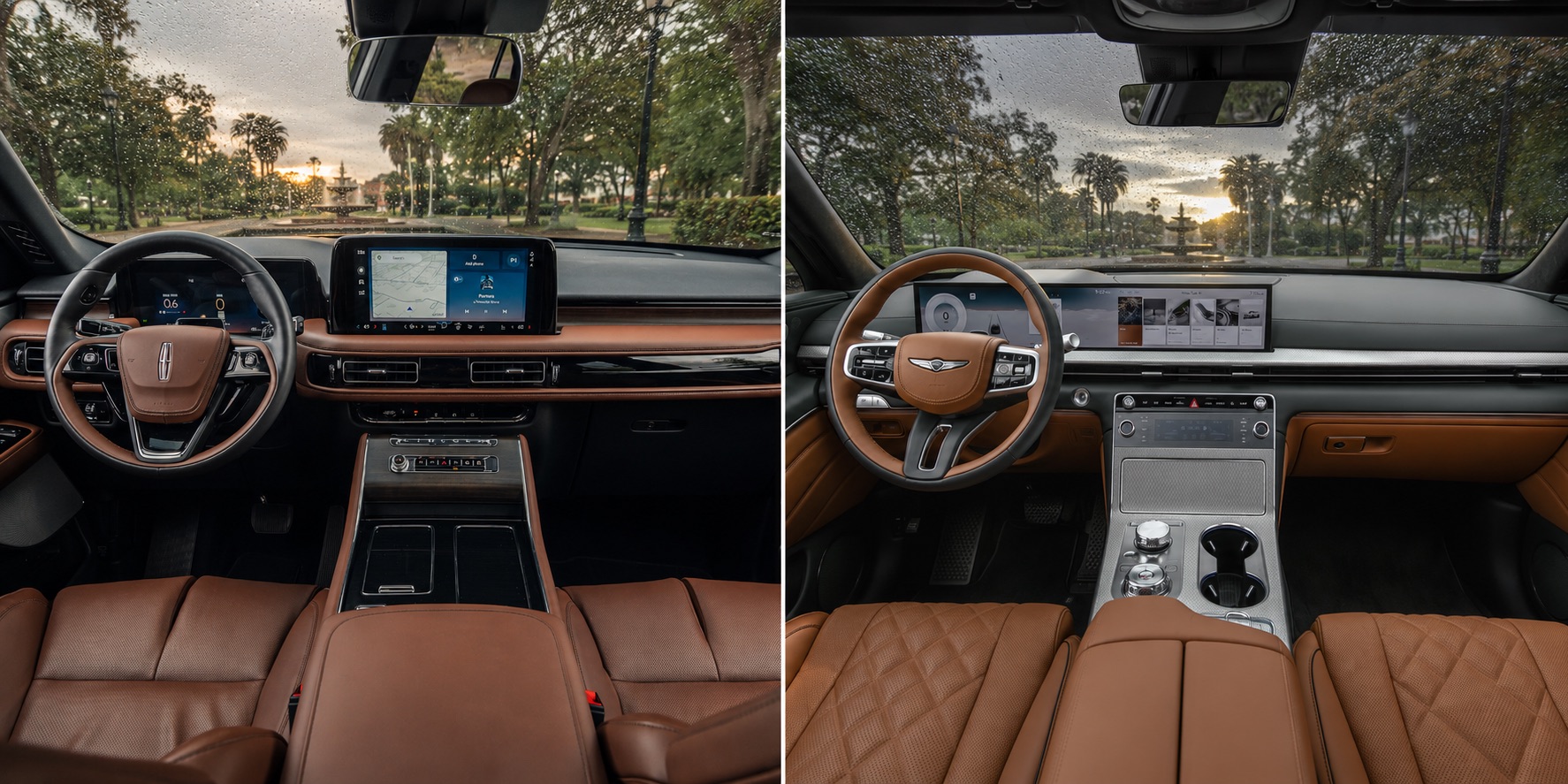
Aviator vs GV80 by Decision Point
Six Decision Points That Separate Aviator From GV80
Pick a category below to focus the comparison. On a narrow display, swipe the tabs and scroll a wide table when needed.
At a Glance
Similar Entry Prices, Very Different Standard-Equipment Priorities
Lincoln puts more power and hands-free highway driving into the base formula; Genesis answers with efficiency, towing headroom, and longer coverage.
What the Opening Numbers Mean
The starting-MSRP difference is only about 1%, so price alone does not separate these SUVs. Aviator pairs that near-equal entry price with 100 more standard horsepower and included BlueCruise; GV80 answers with better base fuel economy, a higher tow rating, and the longer ownership coverage examined later.
Powertrains & Efficiency
Aviator Standardizes the Stronger Engine;
GV80 Lets You Choose Efficiency or V6 Power
The Lincoln avoids an engine upgrade ladder. Genesis uses two powertrains to give buyers a more explicit efficiency-versus-performance choice.
Powertrain Takeaway
Aviator has the clear standard-output advantage: its base engine makes about 33% more horsepower than the GV80 2.5T and still exceeds the GV80 3.5T on paper. The 2.5T earns Genesis a 3-mpg city and 1-mpg highway advantage over Aviator RWD; moving to the 3.5T narrows the power difference but gives up that four-cylinder efficiency benefit.
Space & Utility
Aviator Carries More Behind Row 3;
GV80 Gives Row 3 Slightly More Legroom and More Tow Capacity
The exterior-size advantage does not translate into a clean passenger-space sweep, so third-row room, luggage space, and towing are more useful decision points.
What the Packaging Difference Means
Aviator is 5.2 inches longer overall, but GV80 publishes 1.1 inches more third-row legroom. The larger packaging difference appears behind an occupied third row, where Aviator provides 16.5 cubic feet versus 11.6; with the rows folded, the maximum-cargo gap narrows to 75.9 versus 71.7 cubic feet. GV80’s 1,000-pound higher tow rating is the clearest utility advantage when trailer demand matters.
Ride & Cabin Luxury
Lincoln Leans Into Sanctuary-Like Comfort;
Genesis Mixes Rich Materials With More Display Theater
Both can be lavish, but they create the premium experience with different suspension, seating, audio, and design choices.
Comfort Takeaway
This is the section where a test drive and seat check matter most. Aviator combines adaptive suspension, available Air Glide, and available 30-way front seats; GV80 counters with available Road Preview suspension, a display-forward cabin, and available second-row heating, ventilation, and power reclining. The better luxury experience depends more on the exact trim and how the seats and ride suit you than on the starting MSRP.
Screens & Driver Tech
GV80 Makes the Bigger Display Statement;
Aviator Adds a Different Highway-Assist Capability
Both are highly digital. The meaningful difference is not screen count—it is how the display strategy and highway-assistance systems fit your driving.
Technology Takeaway
GV80 makes the more dramatic display statement with its 27-inch OLED panel. Aviator’s more consequential distinction for some highway-heavy shoppers is BlueCruise, because four years of access are included and the system permits hands-free operation on compatible roads. HDA 2 remains useful assistance, but Genesis positions it differently rather than as the same hands-free capability.
Trims, Warranty & Value
Aviator Keeps the Lineup Simple;
GV80 Offers More Steps and Longer Coverage
The entry prices are close, but the ownership math changes with powertrain choice, top-trim pricing, warranty duration, and included service benefits.
What the Ownership Math Means
The roughly 1% base-price difference is too small to settle the value question by itself. Aviator includes the 400-hp V6 and BlueCruise at its entry point, while the first published GV80 3.5T starts $18,005 above the GV80 base and should be compared against a more similarly priced Aviator configuration. Genesis’s longer warranty, included scheduled maintenance, and broader sequence of intermediate trims can matter more to buyers who prioritize ownership coverage or want finer price-and-equipment steps.
Independent Review Context
Independent Reviews Reinforce Two Different Luxury Priorities
Car and Driver’s current reviews reinforce the same split the specifications reveal: the Aviator stands out for strong V6 performance and a comfort-oriented ride, while the GV80 earns praise for its richly finished cabin, quiet-road refinement, and feature-to-price balance.
Car and Driver
2027 Lincoln Aviator
Strong acceleration and a cushioned ride support the Aviator’s comfort-first identity.
Car and Driver highlights the Aviator’s twin-turbo V6 and cushy road manners. In its AWD Reserve testing, the SUV reached 60 mph in 5.6 seconds and returned 24 mpg on the publication’s 75-mph highway fuel-economy route. Those results add independent context to Lincoln’s strongest themes here: effortless performance and relaxed long-distance travel.
Car and Driver
2027 Genesis GV80
Rich materials, quiet-road refinement, and broad standard equipment give the GV80 a convincing luxury case.
Car and Driver praises the GV80’s first-class interior, smooth and quiet ride, and strong equipment value. Its testing recorded 0–60 mph in 6.1 seconds for a 2.5T AWD and 5.7 seconds for a 3.5T AWD, while the 2.5T AWD returned 25 mpg on the publication’s 75-mph highway route. That supports Genesis’s appeal as a well-rounded luxury package rather than a horsepower-first alternative.
Put the Lincoln Side Into a Real Build
Compare the Aviator You Would Actually Buy, Not Just the Starting Price
The paper comparison gives direction; current inventory shows whether the Premiere, Reserve, or Black Label configuration you want is actually available with the drivetrain, seating, suspension, and comfort equipment you prefer. Pair that finished vehicle with a current trade value to judge the Lincoln side against a realistic budget.

Where the Decision Actually Lands
Which Kind of Luxury Will You Notice
Every Time You Use the SUV?
Choose the Aviator when standard performance and hands-free highway driving are priorities. The starting-price gap is only about 1%, but the Lincoln’s standard engine makes roughly 33% more horsepower than the GV80 2.5T, and four years of BlueCruise access are included. That is a meaningful hardware-and-technology advantage without moving up an engine tier.
Choose the GV80 when efficiency, towing, or long-term factory coverage matter more. Its 2.5T RWD advantage is 3 mpg in the city but only 1 mpg on the highway, while its 6,000-pound tow rating is a more substantial 20% above Aviator’s maximum. Genesis also provides longer basic and powertrain coverage plus scheduled maintenance, and its three-row configuration offers slightly more third-row legroom.
The most revealing cross-shop is still around the entry price. Aviator gives more engine and BlueCruise; GV80 gives better four-cylinder efficiency, a 27-inch OLED presentation, and the longer ownership package. If you move to the GV80 3.5T, the original base-price comparison no longer applies—the first published V6 configuration starts much higher, so compare its finished price against the Aviator trim that is actually closest in budget and equipment.
See How Your Priorities Combine in the Best-Fit Model Quiz Below
Treat the quiz as a shopping shortcut only; verify pricing, installed equipment, seating, towing limits, warranty terms, and test-drive impressions before choosing.
2027 Lincoln Aviator vs Genesis GV80 FAQ
Shopping & Ownership Support
Make the Lincoln Side Easier to Verify & Easier to Own
— at J.C. Lewis Lincoln Savannah
J.C. Lewis Lincoln Savannah serves Coastal Georgia and nearby South Carolina Lowcountry shoppers from 9505 Abercorn Street, backed by more than 108 years of J.C. Lewis automotive history. The dealership emphasizes transparency, long-term relationships, and Lincoln-focused guidance, with home delivery available throughout the Southeast for shoppers who prefer to complete more of the process remotely.
In this comparison, the dealership’s best role is practical: help you inspect and drive the Aviator configuration you would actually buy, verify its drivetrain, seating, suspension and comfort equipment, review the window sticker, and put trade value and financing against the finished vehicle. That does not erase the GV80’s warranty, towing, or efficiency advantages; it makes the Lincoln side specific enough to judge on equal terms.
Ownership support extends beyond the showroom. J.C. Lewis Lincoln uses factory-trained technicians and genuine Lincoln parts, offers Lincoln Pickup & Delivery for qualifying service visits, and provides mobile-service support and flexible scheduling. For an SUV used for Savannah errands, airport runs, Hilton Head or Beaufort trips, and longer I-95 travel, those services can reduce the time ownership takes out of the schedule.
Where to Go Next
Start Shopping or Keep Researching
Move from comparison to the next useful step: price a real Aviator with your trade and financing in view, or go deeper into Lincoln ownership, Black Label, size, and maintenance information.
Start Shopping
Price the Aviator You Would Actually Drive
Check availability, factor the trade into the budget, and move toward financing or a direct conversation about your ideal Lincoln.
Keep Researching
Research the Lincoln Questions That Still Matter
Use our research hub for broader model context, comparisons, Black Label ownership, and maintenance planning.
Disclaimers:
*Manufacturer starting MSRPs, specifications, fuel-economy figures, towing figures, feature availability, and ownership-program terms were checked September 2, 2026 and can change. Lincoln currently publishes Aviator Premiere from $58,245; Genesis publishes GV80 2.5T RWD from $58,850. Manufacturer fee treatment can differ; taxes, title, registration, destination, options, dealer charges, incentives, and transaction prices may change the comparison.
*Published output figures used in this comparison are: Aviator 3.0L twin-turbo V6 — 400 horsepower and 415 pound-feet; GV80 2.5T — 300 horsepower and 311 pound-feet; GV80 3.5T — 375 horsepower and 391 pound-feet. Certain emissions-market Aviator configurations may differ, so confirm the exact vehicle, certification, window sticker, and installed equipment.
*EPA fuel-economy estimates are for comparison only. Actual mileage varies with drivetrain, equipment, driving conditions, driving habits, weather, load, maintenance, and other factors.
*Lincoln lists the 2027 Aviator at up to 5,000 lbs of towing when properly equipped. Current Genesis GV80 specifications list a 6,000-lb maximum braked-trailer weight. Never exceed vehicle, hitch, axle, tire, payload, tongue-weight, or trailer ratings; passengers, cargo, accessories, and options can reduce available capacity. Confirm the exact vehicle’s labels and applicable owner/towing documentation.
*Seating, third-row equipment, cargo access, suspension, audio, materials, displays, driver-assistance features, security features, and comfort equipment vary by trim, configuration, package, activation, subscription, and market. GV80 cargo figures in the comparison apply to the three-row SUV configuration; cargo/load capacity is limited by weight and weight distribution.
*BlueCruise and Highway Driving Assist 2 are driver-assistance technologies, not autonomous-driving systems. The driver must remain responsible for the vehicle and follow each system’s operating requirements. BlueCruise hands-free operation is limited to compatible mapped Blue Zones and requires monitoring plus applicable activation; Genesis HDA2 has separate availability and operating conditions.
*Warranty, Pickup & Delivery, complimentary maintenance, Service Valet, Black Label benefits, connected services, and other ownership programs are subject to eligibility, original-owner or lessee status where applicable, exclusions, retailer availability, time/mileage limits, activation requirements, program rules, and change. Review the applicable warranty and program documents before purchase.
*Car and Driver test results and editorial observations referenced in the independent perspective were checked September 2, 2026 and can change. External review links are provided for independent perspective; J.C. Lewis Lincoln does not control third-party content.